I have a friend, and this friend gives me fun problems. I will turn this into a series and post the interesting problems and solutions here.
For this problem, I know that this solution exists online. However, I want to try to solve it on my own first (with some internet assistance, LOL). I will also keep an update log for any corrections to the solution (as I may be wrong with my original blog post).
The Problem
The problem is as follows:
You have a sequence of positive real numbers such that . Must there exist infinitely many positive integers such that
Intuition: Convexity
The first thing I saw was a midpoint inequality.We can graph the points on the Cartesian plane. This creates a set of points. Meanwhile, we can look at the inequality: . This is equivalent to saying that the point is below the midpoint of the points and . Using an example , we can see that this applies. An image is provided below.
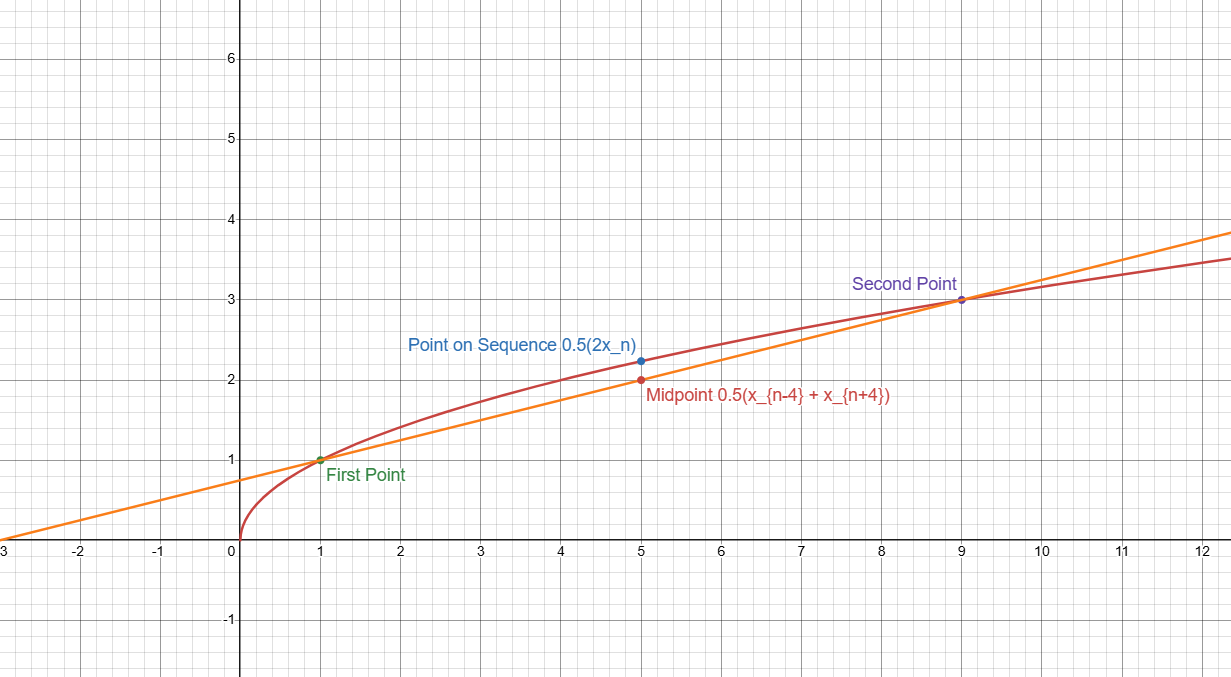
Example of a sequence that satisfies the midpoint inequality. (source)
As we can see, the midpoint inequality is satisfied. The straight line is the midpoint of the two points, and the curve point is above the straight line. However, this is only an example, and we need to show that this is true for ALL sequences for infinitely many points.
To do this, we use the upper convex hull.
Upper Convex Hulls
To understand what a convex hull is, we first need to go over the convex set.A set of points in a plane is convex if for any two points and in , the line segment that connects and is also in .
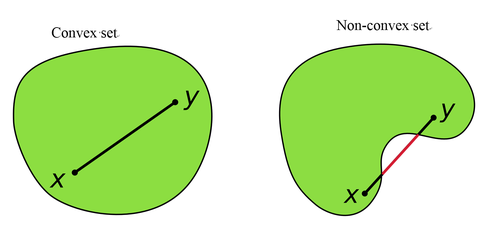
Visualization of Convexity (source)
There are some other mathematical definitions, but let's keep it simple. Now, a convex hull of any set of points is the SMALLEST CONVEX SET that contains all of the points in .
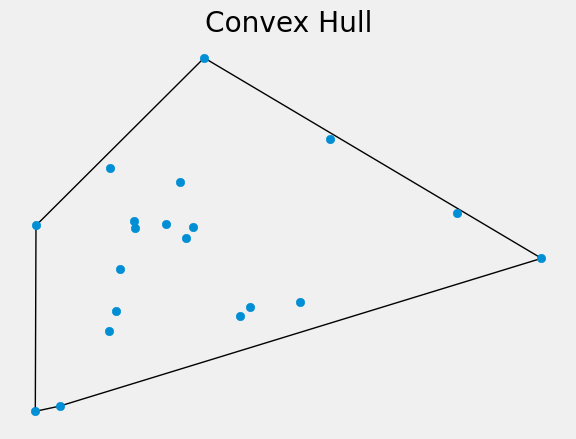
Visualization of a Convex Hull (source)
Meanwhile, the upper convex hull of a set of points is the part of the convex hull that is above the points in .
Looking at the Upper Convex Hull
Going back to the problem, we have discrete points . We can look at the upper convex hull of these points and prove two things:To do the first part, we will use contradiction.
There's our proof that there are infinitely many points on the upper convex hull. The second part is easier!
By the definition of the upper convex hull - a convex set - we know that any boundary point on the upper convex hull lies above the midpoint of any two points and since they are in the convex set.
Conclusion
Since both points are proven, we can conclude that there are infinitely many points that satisfy the problem's inequality. In other words, yes.This was a fun problem! An update log will be provided below for any corrections to the solution. I will try to keep it as organized as possible!